The Complexities of Today’s Modern IT Environments
Gartner research indicates that most organizations have between three and eight scheduling and automation tools in place. That’s because as IT and business environments become more complex, many IT teams attempt to simplify with an array of application- and platform-specific scheduling and automation tools and scripts. This approach, however, results in multiple licensing, support, and training costs, greater resource requirements and manual efforts, and more complexity.
To gain maximum benefits from workload automation, organizations must take a more holistic approach.
ActiveBatch Workload Automation provides a central point of control that reliably manages operational requirements, complex dependencies between workflows, and technology integrations across the enterprise.
A Scalable Automation Architecture for All Your Needs
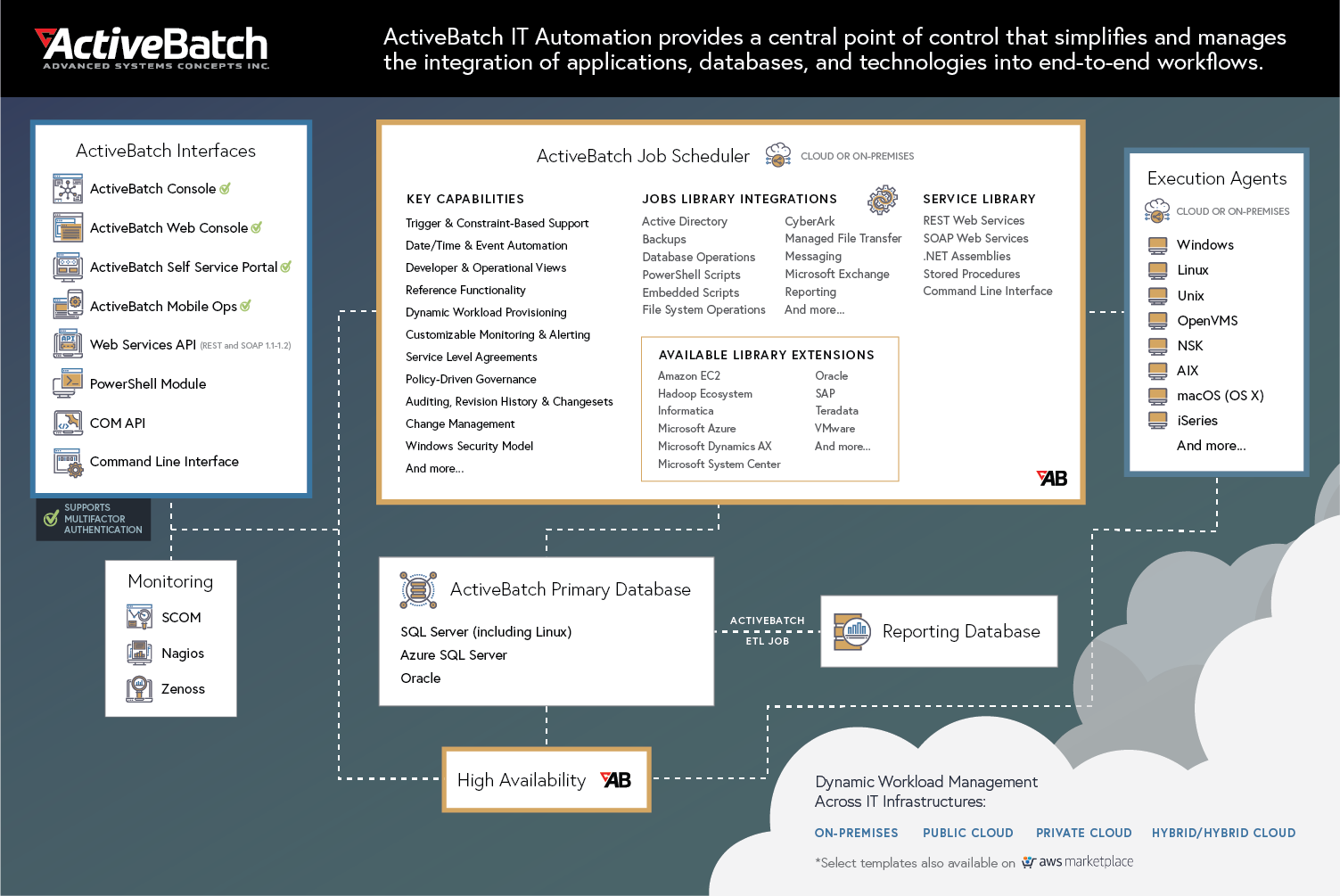
ActiveBatch Workload Automation is client-server based, and all aspects of ActiveBatch can be fully distributed, giving users a highly flexible, scalable solution. ActiveBatch consists of three major components:
These components can reside on either a single machine or multiple machines, and each component can have multiple instances.
Job Scheduler
The ActiveBatch Job Scheduler is responsible for the overall orchestration and operation of the ActiveBatch system and manages several types of ActiveBatch Objects, including jobs and plans.
Execution Agents
Execution agents are the cross-platform components responsible for running ActiveBatch Jobs. Once a job is ready to execute, the job scheduler communicates with a server’s execution agent. The execution agent is the cross-platform component of the ActiveBatch system, supporting:
- Windows
- Linux
- UNIX
- z/OS
- AIX
- NSK
- OS X
Programmatic Interfaces
- ActiveBatch Web Console
- ActiveBatch Self-Service Portal
- ActiveBatch Mobile Ops App
- Web Services API
- .NET/COM API
- PowerShell Module
- Command Line
Improve Job Success Rate with High Availability
With ActiveBatch’s Non-Cluster Failover Add-In, organizations can experience reliable high availability in the event of a potential outage or failure. ActiveBatch Non-Cluster Failover operates in active-standby mode, monitoring the heartbeat of the job scheduler. If there is a failure or an outage, or the primary job scheduler is otherwise determined to be unresponsive, jobs and plans will be directed to standby systems so they are executed and completed on or near schedule.
ActiveBatch Non-Cluster Failover for High Availability allows for:
- Dynamic failover due to loss of an application (job scheduler), server/VM, or connectivity from job scheduler to database, to ensure jobs run as scheduled.
- Manual failover from the primary job scheduler to a standby job scheduler at times when a server needs to be patched or when an unexpected reboot is needed.