Simplify IT with Cross-Silo Automation
Modern IT Automation solutions offer a cross-silo approach to reducing costs and simplifying business and IT processes.

Reduce IT’s Silos of Automation
Imagine you just moved into a new home, it’s the beautiful home you always dreamed about, but with one problem —it’s what you would call a fixer upper. Now I’m sure that you (and your wallet) cringe at the idea of home improvement and renovating, and as a homeowner you are faced with many options as to where to begin.
With all the work that needs to be done, would you hire a person to fix the doors, a different person for the windows, a different person to do the floors, the paint, the siding, etc., each requiring their own individual payments, permits, and supervision? Or would you hire a general contractor, someone who’s in charge of managing and overseeing all of these different specialists and their individual tasks? I’m sure that you, like many others, would choose to hire a general contractor to reduce costs and simplify all the home improvement processes required to go from fixer upper to dream home.
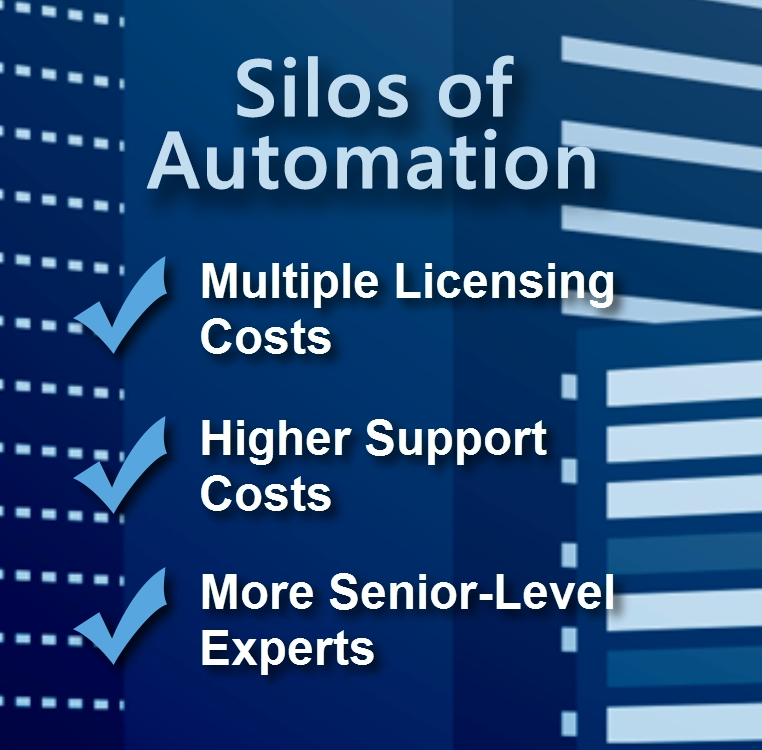
So the question is, when faced with the many complex processes in your organization, why would you treat your IT environment any different? If each department or group is using its own set of automation tools, resulting in costly, complex, silos of automation, why not hire a “construction manager”, a modern IT automation solution, to simplify the management of all the different applications and technologies in your environment?
IT environments are extremely complex; each department is using its own set of tools to satisfy department needs, and there’s often a lot of duplication and overlap with the tools being used. On top of that, since each department head is focused on its own operations, individual departments are unaware of the overlap. A CIO however, looks down on all of these departments from a bird’s eye view like the homeowner looks at his new house. What he or she sees is dozens of different scheduling and automation tools racking up higher costs and slowing down business agility. Purchasing multiple scheduling tools and spending too much time writing custom scripts, each individual department is inadvertently causing the organizations to take a “siloed” approach to automation. What these CIOs need is a single point of control.
Modern IT Automation
A modern IT automation solution eliminates the need for multiple scheduling tools by providing a unified approach to automation for the entire organization. Instead of relying on various different tools with multiple licensing and support costs, a modern IT Automation solution offers a unified solution to reduce costs and simplify business and IT processes. Automation solutions with prebuilt Job Steps and a wide breadth of integrations, including API accessibility, allow developers to create end-to-end workflows, across any technology, application, or platform. As a result, you don’t need a separate tool for every different function or process, and you can minimize your reliance on custom scripting and manual processes.
Taking this approach and managing your IT environment with a modern IT automation solution is like hiring a construction manager to renovate your home —the jobs will all get done and get done right, and it will save you time, reduce costs, and consolidate and centralize your business and IT processes.
Download our White Paper to learn more about how you can centralize your business and IT processes.